
Key points
- From Basic Add-Ons to Best-of-Breed Integration: Basic light-manufacturing modules struggle with complex routing, real-time WIP tracking, multi-location traceability, and automated MRP, making a best-of-breed integration approach essential.
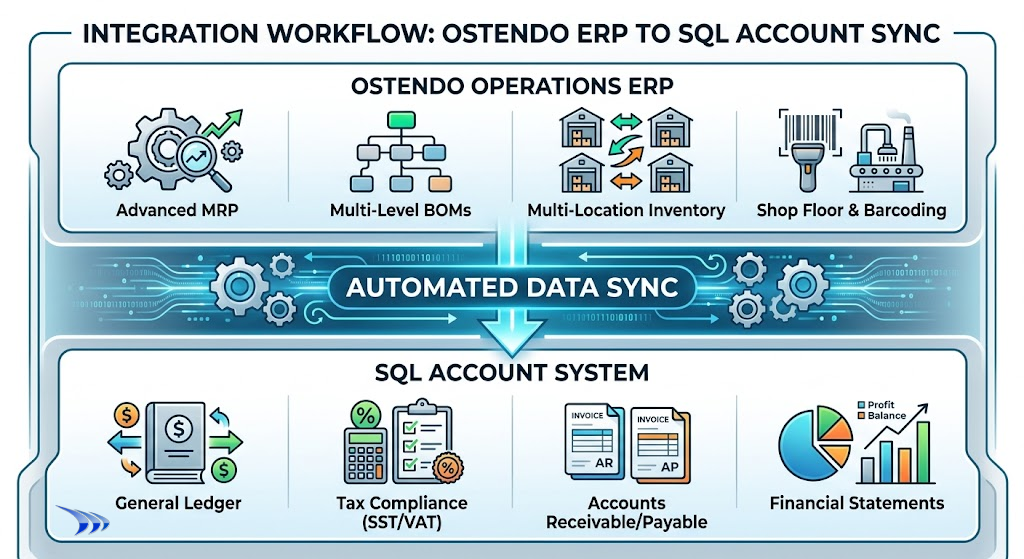
- Ostendo + SQL Account: Roles in the Stack: Ostendo serves as the operational engine for inventory, job costing, and shop floor scheduling, while SQL Account remains the core system for ledgers, tax, and reporting.
- What the Integration Delivers: The integration enables material planning, multi-location inventory tracking, detailed job costing with labor and overhead allocation, and automated data synchronization between Ostendo and SQL Account.
- How the Workflow Flows: Procurement and inventory control in Ostendo drive manufacturing demand; shop floor execution captures labor and materials, and finished jobs automatically update inventory values and GL postings in SQL Account.
- Finance Confidence and Control: The Ostendo–SQL Account bridge lets finance teams stay within SQL Account for payables, receivables, and reporting, while production complexity is managed in Ostendo to reduce disruption and double-entry.
Ostendo ERP Fills the Operational Gap
Bridging the gap between the shop floor and financial compliance is a common hurdle for growing manufacturers. While light manufacturing add-ons and native stock assembly features within SQL Account work initially, scaling businesses often hit an operational ceiling.
Linking specialized operations software like Ostendo Operations ERP with SQL Account provides a robust, seamless workflow for inventory and production control, without forcing your finance team into unfamiliar territory.
Outgrowing Basic SQL Account Stock Modules
SQL Account is an exceptional financial and inventory tool, but its native stock issue, stock assembly, and basic manufacturing modules are designed primarily for light assembly. As production scales, complex operational hurdles emerge:
- Shop Floor & Routing Bottlenecks: SQL Account’s standard setup cannot track multi-stage routing, resource capacity planning, machine scheduling, or real-time Work-In-Progress (WIP).
- Advanced Tracking Deficits: Full batch, lot, serial number, size, color, or expiry date traceability across multiple warehouse locations often exceeds the capabilities of standard accounting add-ons.
- Material Requirements Planning (MRP): Standard stock modules lack dynamic MRP engines that factor in actual supplier lead times, minimum order quantities (MOQ), and sales order forecasts.
To resolve these operational challenges while retaining a trusted General Ledger on SQL Account’s Firebird SQL database, businesses adopt a best-of-breed integration strategy.
The Power of Integration: Ostendo + SQL Account
Ostendo Operations ERP acts as the operational engine, handling dynamic inventory control, deep job costing, shop floor tracking, and production scheduling. SQL Account serves as the core financial backbone, managing accounts payable/receivable, SST compliance, bank reconciliations, and executive financial reporting.
Operational Capabilities Comparison
Feature | Built-in SQL Account Modules | Ostendo + SQL Account Integration |
|---|---|---|
Material Planning | Manual reordering based on min stock | Dynamic MRP driven by live orders, lead times & forecasts |
Inventory Tracking | System-wide warehouse totals | Multi-location tracking down to aisle, rack, row, serial & batch |
Job Costing | Estimated cost/static assembly BOM | Real-time labor, machine, overhead, and landed cost allocation |
Data Synchronization | Manual journal entries & stock adjustments | Automated sync of customers, suppliers, invoices, and GL journals |
How the Integrated Workflow Operates
- Procurement & Inventory Control: Purchase orders issued in Ostendo account for live inventory levels and manufacturing demand. Upon arrival, stock is logged down to specific locations or batches. Supplier invoice details sync straight into SQL Account to eliminate manual double-entry.
- Shop Floor Execution: Work orders run in Ostendo, tracking real-time labor hours, material consumption, and machine usage.
- Financial Posting: Completed jobs update finished goods inventory values. Sales invoices generated from shipped orders flow into SQL Account automatically, reflecting real-time Cost of Goods Sold (COGS) and updating the General Ledger.
Financial Stability Without Operational Compromise
A major concern when introducing enterprise-grade operations software is disrupting the finance department.
With this integration, your finance team does not need to give up the accounting system they are comfortable with. They continue to manage payables, receivables, SST tax compliance, and financial reporting inside SQL Account. Meanwhile, the operations team gains the advanced MRP and shop floor control they need within Ostendo.
Using a different accounting system?
Read our companion guide on Extending AutoCount Inventory to see how Microsoft SQL-based architectures handle operational data sync.
Ready to Streamline Your Operations?
Stop struggling with basic systems and gain the competitive advantage of integrated ERP. At Deltatech, we specialize in complex ERP implementations, ensuring a smooth, tailored setup of your Ostendo Operations ERP to SQL Account integration.
Take the first step toward advanced operational control.