Key points
- Rapid growth reveals operational friction: A fast-growing business experiences surging transaction volumes while inventory and fulfillment become chaotic, revealing that behind-the-scenes gears are slipping and stockouts eroding trust.
- ERP migration is often costly and risky: Forcing a complete ERP overhaul against a reluctant finance team leads to longer deployment, disruption, and reduced administrative productivity, without guaranteeing improved outcomes.
- Accounting and operations have different needs: Accounting systems focus on financial outcomes and compliance, while operational systems require agility, real-time tracking, and detailed handling of inventory and production.
- The recommended approach: an Operational ERP on top of accounting: Ostendo acts as an operational layer that handles inventory, manufacturing, service, and distribution, while still integrating with the existing accounting engine to post journals automatically.
- Concrete operational and financial gains with Ostendo: Benefits include total inventory control, advanced manufacturing and BOM tracking, real-time job costing and service tracking, and seamless financial data transfer back to the accounting system.
It is a classic symptom of a business experiencing rapid, successful growth.
Transaction volumes are surging. Orders are flooding in. But behind the scenes, the operational gears are
beginning to grind, slip, and lock up.
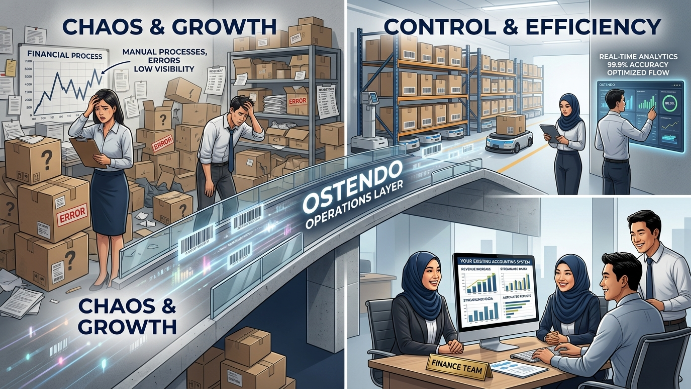
Inventory control has become chaotic, stock-outs are hurting customer trust, and tracking assemblies or deliveries feels like guesswork.
As a business leader, you know you need a comprehensive solution to regain control and streamline your processes.
The natural next step looks like a massive, all-in-one Enterprise Resource Planning (ERP) system.
But when you pitch the idea, you hit a brick wall: your finance team is completely against it. They are happy with their current accounting system. It is stable, compliant, handles tax mandates perfectly, and their processes are finely tuned. They dread the disruption, cost, and high failure risk of a total financial system overhaul. And honestly? They have a valid point.
So, what do you do when your operations are starving for advanced control, but your finance team
refuses to budge?
You don’t force a painful change. Instead, you change the strategy: You decouple operations from core financial accounting using Ostendo.
The Costly Mistake of Forcing an ERP Migration
Many organizations believe that fixing operational chaos requires replacing everything. Forcing a reluctant finance department to abandon a trusted accounting system often leads to severe friction, prolonged deployment timelines, and significant drops in administrative productivity.
Financial systems require precision, stability, and adherence to regulatory frameworks.
Operational systems, on the other hand, need agility, detailed tracking, and real-time responsiveness to physical workflows. Trying to force both into a single, rigid ERP system often satisfies neither department, resulting in an expensive compromise.
The Operational Reality Check
Your accounting system is designed to record financial outcomes, not to drive operational efficiency on the warehouse floor, the service desk, or the production line.
Trying to manage complex inventory matrices or multi-stage assemblies inside a basic ledger system is a recipe for manual workarounds and data errors.
The Solution: An Operational ERP that Integrates Seamlessly
The smartest way forward is to keep your finance team happy while giving your operational team the advanced tools they desperately need.
This is exactly where Ostendo Operations ERP excels.
Ostendo is specifically designed to sit on top of your existing accounting engine. It takes over the heavy lifting of operational workflows, such as inventory, manufacturing, service, and distribution, while linking back to your financial software to drop clean, automated journals where they belong.
By deploying Ostendo, you instantly solve the operational bottleneck without triggering a disruptive accounting migration.
Here is how it transforms your business workflows:
- Total Inventory Control: Move beyond simple stock counts. Ostendo delivers multi-warehouse tracking, serial and batch traceability, barcode scanning, and precise costing (including landed costs for imports). Say goodbye to chaotic spreadsheets and manual stock reconciliation.
- Advanced Manufacturing & Assembly: If you customize, assemble, or manufacture products, Ostendo tracks complex Bills of Material (BOMs), routing, labor hours, and work-in-progress (WIP) values with immaculate accuracy.
- Dynamic Job Costing & Service Tracking: For businesses with projects or field service teams, Ostendo tracks real-time costs against quotes, schedules technicians, and manages preventative maintenance contracts efficiently.
- Seamless Financial Integration: Ostendo handles the chaotic, high-volume operational transactions locally. It then synthesizes and passes financial summaries, cost of goods sold (COGS), and sales data directly into your current accounting platform.
Strategic Alignment: Win-Win Framework
For the Operations Team: Real-time visibility into stock levels, automated procurement alerts, streamlined order fulfillment, and accurate tracking of labor and materials.
For the Finance Team: No learning curve for a new ledger, zero disruption to historical financial data, pristine audit trails, and automated financial journals with no manual double-entry.
Gaining Control Without Creating Friction
Scaling a business shouldn’t mean breaking the systems that already work.
By implementing Ostendo as your operational layer, you respect the finance team’s need for accounting stability while empowering the rest of your organization with industrial-strength operational control.
You gain the data integrity, process automation, and real-time scaling capacity of a tier-one enterprise
system, at a fraction of the cost, implementation time, and cultural friction.